The Work Beneath the Work
You arrive before the others.
Not because you’re more committed. Because you need the building to yourself for a bit. Because small talk in the corridor before 8am costs something, and you’d rather spend that on the students.
Thanks for reading Pattern & Thread! Subscribe for free to receive new posts and support my work.
By the time the day officially starts, you’re already running.
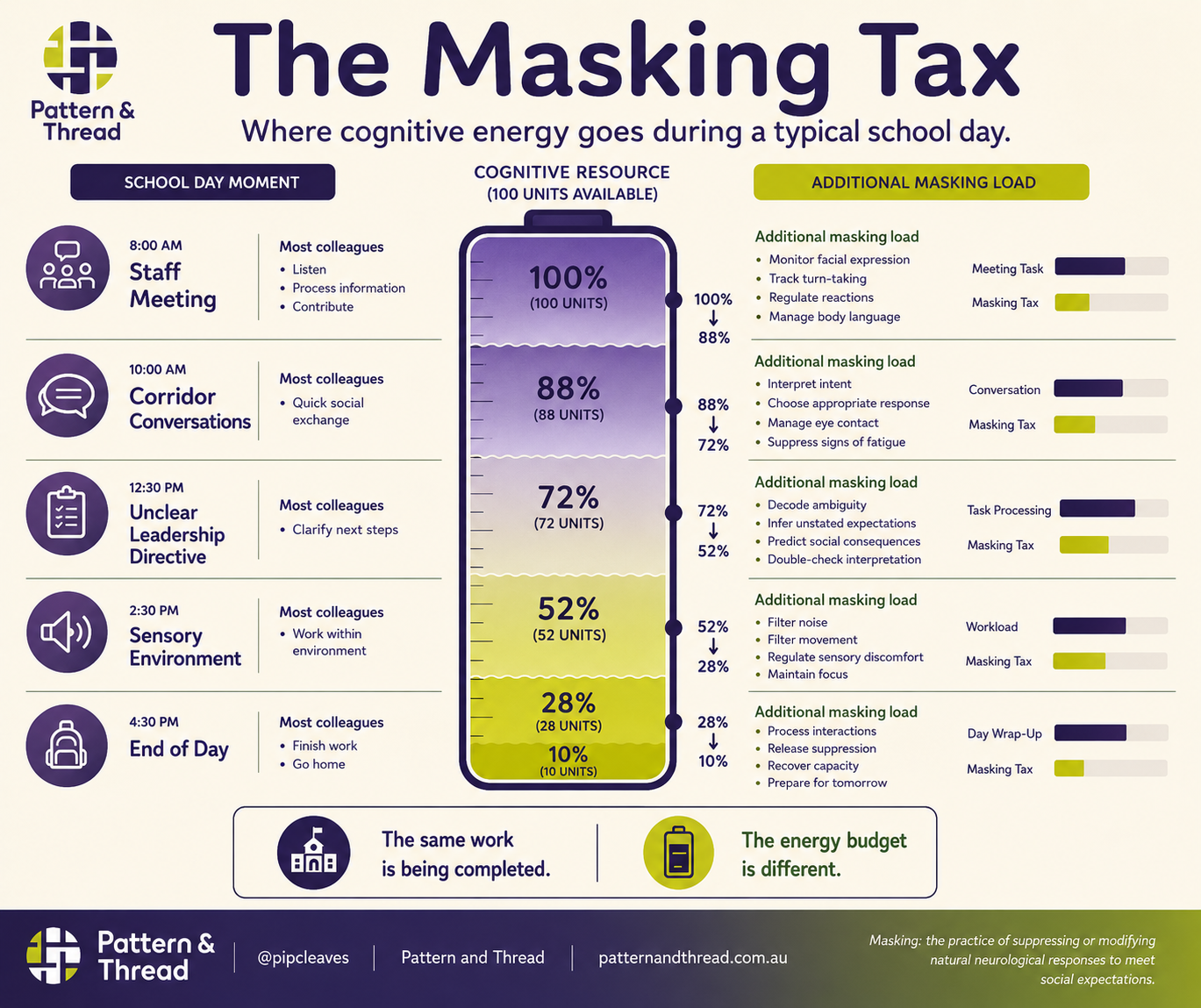
The staff meeting is fine. You know how to do staff meetings. You follow the content, track the room, monitor your own face, manage whatever your hands are doing, and calculate when to speak and how much. Your colleague next to you is just... listening.
Same room. Different work.
Mid-morning. Corridor. Someone stops you for a quick chat. Friendly, unremarkable. You interpret their tone, calibrate your response, manage eye contact, find the exit. Thirty seconds. You won’t consciously remember it by lunch.
Your nervous system will.
An unclear directive lands. An email. A comment in passing. Something from leadership that could mean two different things. A colleague clarifies and moves on. You decode it, re-decode it, anticipate how your interpretation might be wrong, rehearse how to ask without making a fuss. Then you clarify. Then you move on.
Same outcome. Different cost.
By afternoon the sensory load has been accumulating for hours. Lights. Noise. Movement at the edges of your vision. The effort of staying regulated in a building that was never designed with your nervous system in mind.
You’re still teaching. Still planning. Still present.
You’re doing it on reserves.
End of day. Colleagues pack up and head out. You need a minute first. Not laziness. Not being unsocial. You need to process the day, release what you’ve been holding, recover enough to be a person again at home.
That’s not a personal failing. That’s arithmetic.
One thing to try
Start naming the tax as it happens. Not out loud. Just internally. That conversation cost something. That ambiguous email cost something. You don’t have to fix it or explain it to anyone. Just stop letting it disappear into a general fog of depletion that you then blame on yourself.
When you can see where the energy goes, you start making different choices. Protect your transition time. Build recovery in rather than hoping it turns up. Notice which moments are highest cost and whether anything around them is within your control.
You’re not managing your energy badly. You’re managing more of it than anyone around you can see.
And for school leaders
Your ND staff aren’t struggling because the work is too hard.
They’re doing the same job as everyone else. They’re also running continuous background processes that most workload models don’t account for and most school cultures don’t see.
The same care schools are learning to extend to neurodivergent students is owed to the adults in the building. Clear communication. Flexible meeting formats. Environments that don’t require constant sensory management. Permission to work in ways that actually fit.
This isn’t a wellbeing add-on. It’s a design problem. Schools have all the conditions to solve it -- if they decide it’s worth solving.
That’s the work Pattern & Thread is here to do. Launching July 2026. Follow along, or reach out if you want to start the conversation now.
If this landed, share it with someone who needs to read it.