The wrong question
When a neurodivergent staff member is struggling, most schools respond well.
A conversation. A mentor. A coaching referral. A PD recommendation. A shift of classes or roles. A nudge toward counselling or an EAPs session.
The intent is genuine. The care is real.
And almost none of it reaches the thing.
Not because the support is wrong. Because the question underneath it is.
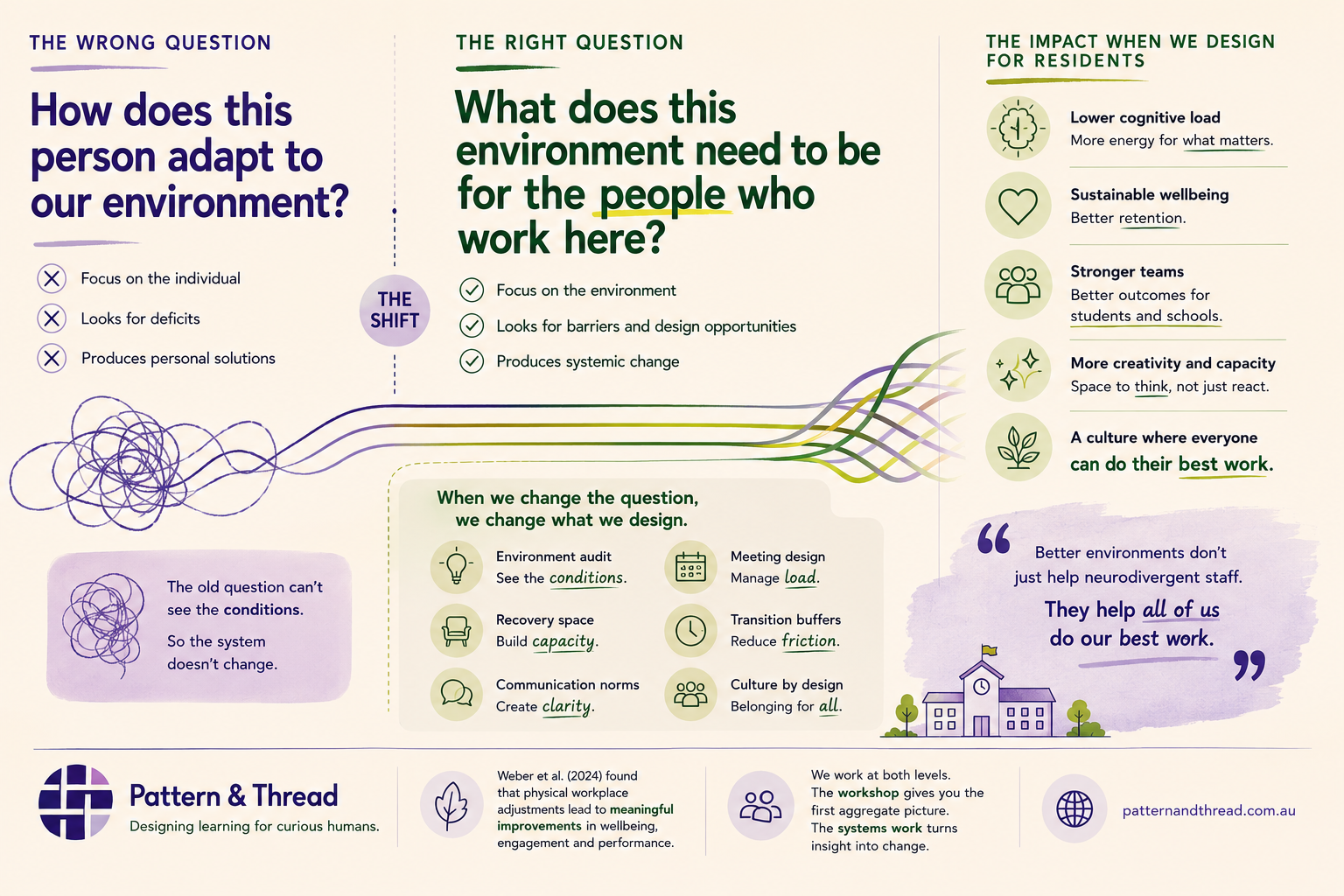
Every one of those responses answers the same question: how does this person adapt to our environment? It’s a personal question. It produces personal answers. And it leaves the environment completely untouched.
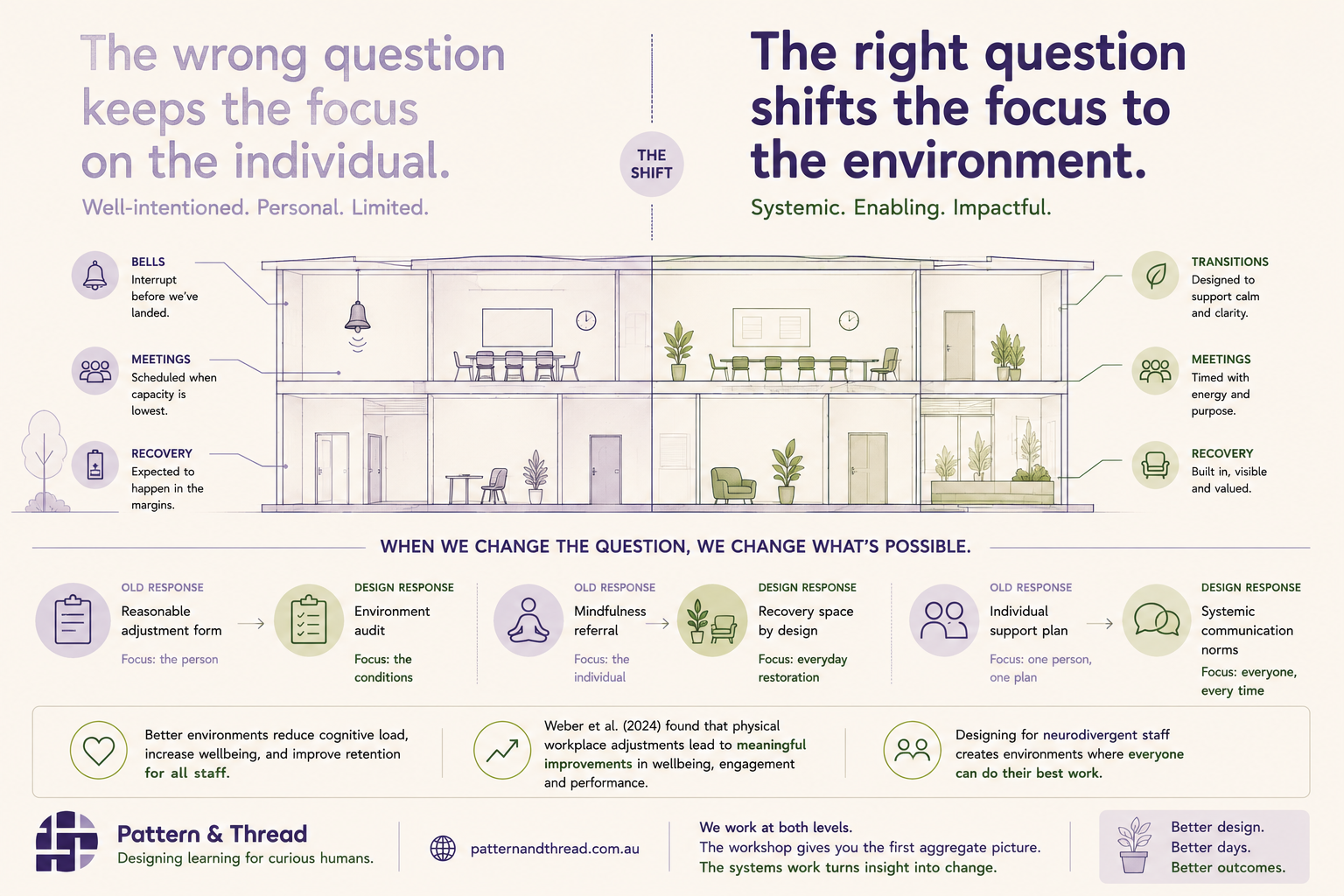
The staffroom stays open-plan. The bells still fire eight times a day. The 3.30 meeting still happens when cognitive reserves are gone. Communication stays ambiguous. The sensory load keeps accumulating – quietly, in the people absorbing it.
The individual gets support. The conditions stay fixed. Six months later, the same conversation happens again. Same school. Same role. Sometimes the same person. Sometimes a different one.
This isn’t a criticism of leaders who respond this way. It’s a description of what happens when the question is too small for the problem.
How does this person adapt? can only ever produce personal answers. It can’t see the conditions because it isn’t looking at them.
A different question produces different answers.
What does this environment need to be for the people who work here?
That question looks at different things. Not capacity to cope – conditions generating the load. Not how to support someone through an environment – whether the environment needs to change.
Weber et al. (2024) found that physical workplace adjustments produce meaningful improvements in wellbeing and performance for neurodivergent workers. Not adjustments to the person. To the conditions.
The environment is a design problem. Design problems have design solutions.
In a school that looks like: auditing where sensory load accumulates and what reduces it. Communication norms that don’t require constant inference. Meeting design that accounts for cognitive load, not just agenda items. Transition buffers. Recovery space that exists for staff, not just students. A staffroom that functions as a rest point rather than a social obligation.
None of it radical. None of it expensive. All of it requiring a different starting question.
The shift matters for neurodivergent staff because the personal response – however well-delivered – still places the adaptation burden on the person least resourced to carry it. They already know how to adapt. They’ve been doing it for years.
It matters for school leaders because the personal response doesn’t hold. Schools that keep losing good ND staff aren’t failing to support them personally. They’re failing to ask
A conversation. A mentor. A coaching referral. A PD recommendation. A shift of classes or roles. A nudge toward counselling or an EAP.
The intent is genuine. The care is real.
And almost none of it reaches the thing.
Not because the support is wrong. Because the question underneath it is.
Every one of those responses answers the same question: how does this person adapt to our environment? It’s a personal question. It produces personal answers. And it leaves the environment completely untouched.
The staffroom stays open-plan. The bells still fire eight times a day. The 3.30 meeting still happens when cognitive reserves are gone. Communication stays ambiguous. The sensory load keeps accumulating – quietly, in the people absorbing it.
The individual gets support. The conditions stay fixed. Six months later, the same conversation happens again. Same school. Same role. Sometimes the same person. Sometimes a different one.
This isn’t a criticism of leaders who respond this way. It’s a description of what happens when the question is too small for the problem.
How does this person adapt? can only ever produce personal answers. It can’t see the conditions because it isn’t looking at them.
A different question produces different answers.
What does this environment need to be for the people who work here?
That question looks at different things. Not capacity to cope – conditions generating the load. Not how to support someone through an environment – whether the environment needs to change.
Weber et al. (2024) found that physical workplace adjustments produce meaningful improvements in wellbeing and performance for neurodivergent workers. Not adjustments to the person. To the conditions.
The environment is a design problem. Design problems have design solutions.
In a school that looks like: auditing where sensory load accumulates and what reduces it. Communication norms that don’t require constant inference. Meeting design that accounts for cognitive load, not just agenda items. Transition buffers. Recovery space that exists for staff, not just students. A staffroom that functions as a rest point rather than a social obligation.
None of it radical. None of it expensive. All of it requiring a different starting question.
The shift matters for neurodivergent staff because the personal response – however well-delivered – still places the adaptation burden on the person least resourced to carry it. They already know how to adapt. They’ve been doing it for years.
It matters for school leaders because the personal response doesn’t hold. Schools that keep losing good ND staff aren’t failing to support them personally. They’re failing to ask the right question about the place those staff are working in.
Better environments don’t just help neurodivergent staff. They lift conditions for everyone in the building.
This is what Pattern & Thread works on in its ‘The Neurodivergent Staffroom’ focus area. .
The workshop gives schools their first real picture – what the staff profile looks like, where load concentrates, what a different design brief might address. The systems work turns that into change.
The question is available to any school willing to ask it.
What does this environment need to be for the people who work here?
That’s where it starts.
School leader – if this landed, reach out. Not a pitch. A conversation about what you’re seeing.
Neurodivergent educator – the next piece goes into what a different design brief actually produces.