DESIGNED FOR VISITORS
Every design decision in a school was made with students in mind.
Thanks for reading Pattern & Thread! Subscribe for free to receive new posts and support my work.
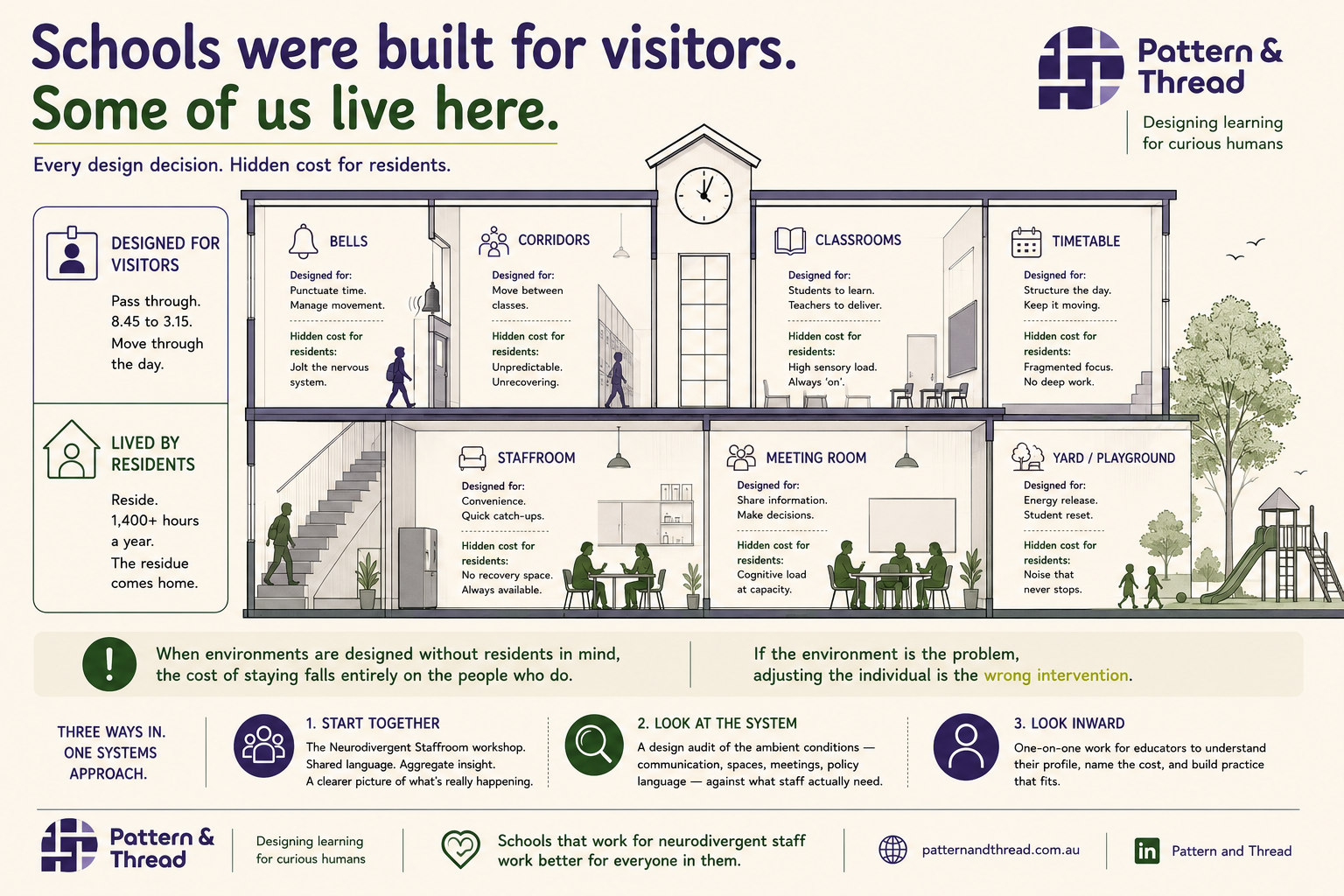
The lighting. The acoustics. The rhythm of the day. The way spaces open onto each other. The bells. The timetable. The assumption that social intensity is temporary, that noise is manageable, that the environment is a backdrop you move through rather than a place you inhabit.
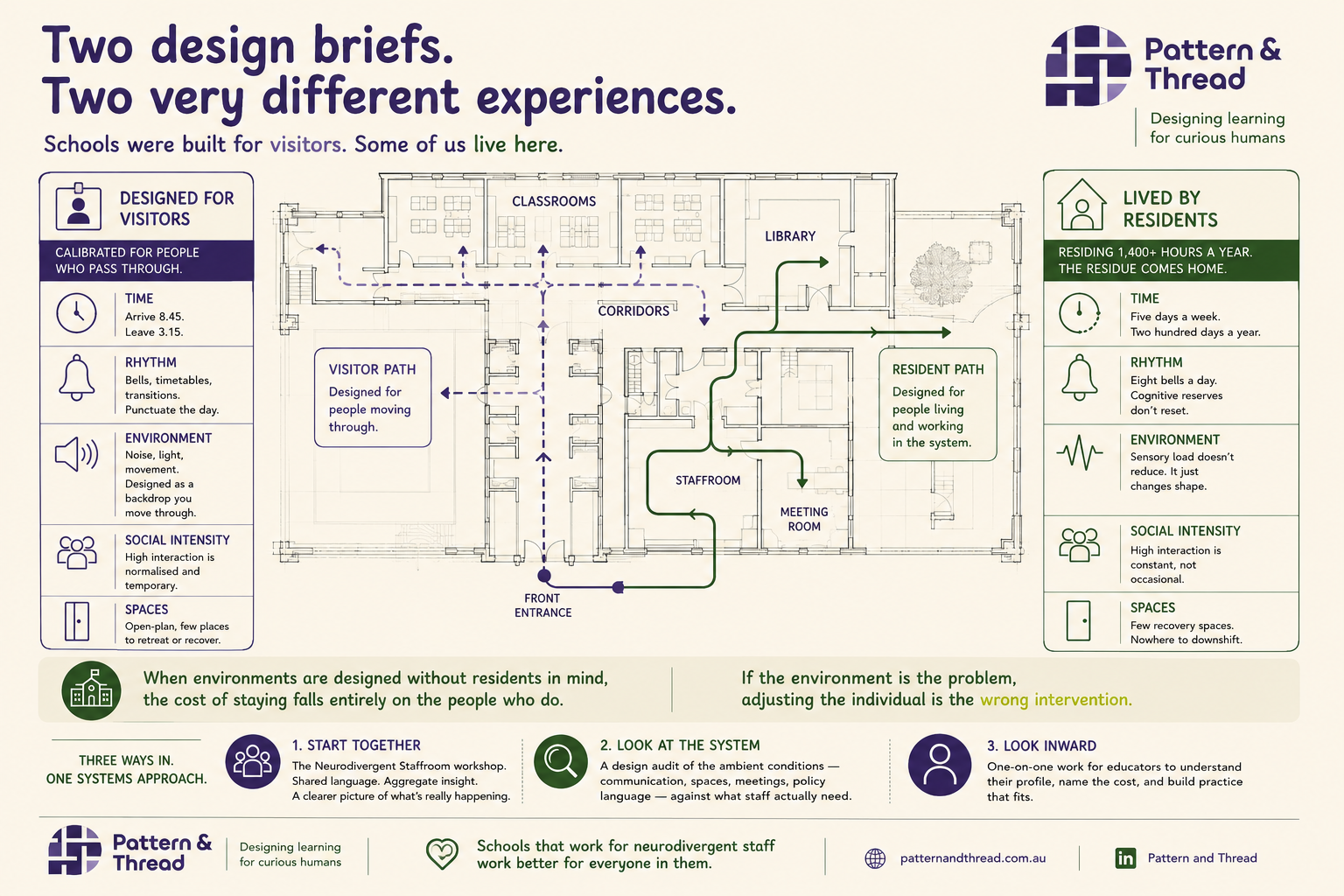
All of it calibrated for people who arrive at 8.45 and leave at 3.15.
Schools were built for visitors. Some of us live here.
The average student spends around 1,000 hours a year in a school building. The average teacher spends closer to 1,400 -- and carries the residue of it home. Two hundred days. The same corridors, the same staffroom, the same sensory conditions. Not passing through. Residing.
When the environment was designed without residents in mind, the cost of staying in it falls entirely on the people who do.
For neurodivergent staff, that cost is structural. Not incidental, not occasional -- baked into the conditions of the job. The open-plan staffroom that offers no recovery space. The bells that punctuate the nervous system eight times a day. The meeting at 3.30 when cognitive reserves are already spent. The ambient unpredictability of a building full of children, where the sensory load doesn’t reduce between lessons -- it just changes shape.
None of this was designed to be hard. It was designed for someone else.
Spiegler et al. (2025) found that workplace culture -- not just workload -- is a primary driver of belonging and exclusion for autistic educators. The physical and social environment shapes whether a person can bring their actual capacity to work, or whether they spend it managing the environment first.
If the environment is the problem, adjusting the individual is the wrong intervention.
This is where most school approaches to neurodivergent staff stall. The response is almost always personal -- a conversation with HR, a reasonable adjustment form, a suggestion to try mindfulness. The design of the school day, the staffroom, the meeting culture, the communication norms -- those stay fixed. The person is expected to adapt to conditions that were never built for them and find a way to perform fully anyway.
The adjustment burden sits entirely with the individual. The institution remains unchanged.
A systems approach asks a different question. Not “how does this person adapt to our environment” but “what does our environment need to be for the people who spend their working lives in it.”
That question changes what you look at. It changes what you audit, what you redesign, what you protect. It moves the work from pastoral care to design practice.
This is the work Pattern & Thread is built to do.
The Neurodivergent Staffroom workshop is a starting point -- a session that gives staff a shared language for their own sensory and cognitive profiles, and gives schools their first real picture of the aggregate experience in the building. What it surfaces often surprises leadership. Not because the experiences are new, but because nobody has asked about them at scale before.
From there, the work can go deeper. A systems engagement that audits the ambient conditions -- communication norms, physical environment, meeting design, policy language -- against what the staff profile actually needs. Not a wellbeing program. A design audit.
Or it can go inward. One-on-one work with individual educators who want to understand their own profile, name what it costs them, and build practice that fits how they actually work.
Three entry points. One argument underneath all of them: schools that work for neurodivergent staff work better for everyone in them.
If you’re a school leader reading this and something in it landed -- that’s worth a conversation. Not a sales call. A conversation about what you’re seeing in your staff and whether a different design brief might help.
If you’re a neurodivergent educator and this is just your life, named: the workshop is open for individuals too. And there’s more coming.